Told from Above · серия Shramko 360
 Автор: Андрей Шрамко
KiteWeekend в Jeziorna Osada, Гноево — полёт 360° с гидом
- 8 мин
- 360° · 8K
- Открытые субтитры
- Онлайн с 18 октября 2026 г.
В битве при Легнице в 1241 году использовали воздушных змеев в форме драконов.
О фильме
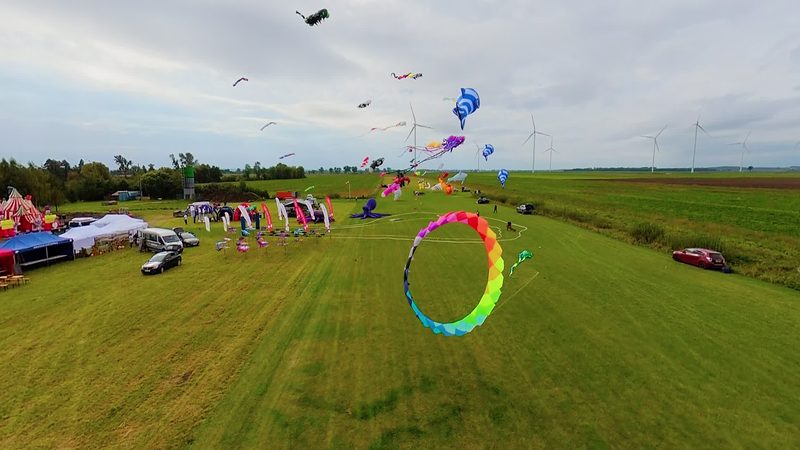
Сегодня над польдерами Жулав летают драконы, рыбы-клоуны, осьминоги и акулы. Гмина Милорадз провожала лето в Гноеве, а фестиваль KiteWeekend собрал на поле в Jeziorna Osada любителей воздушных змеев со всей Польши. В этом фильме я пролетаю над фестивалем и поднимаюсь над Жулавами.
Гид рассказывает, в частности, как дежурный по станции Альфонс Руновский в Шиманкове перекрыл стрелкой путь неизвестному поезду без огней. Ещё одна история из фильма: в 1887 году человек по имени Арчибальд первым закрепил фотоаппарат на воздушном змее и сделал с его помощью снимки с воздуха.
Кто приезжает на Жулавы, попадает на землю, отвоёванную у воды: самая низкая точка Польши находится в Рачках-Эльблонских.
Места в фильме
- Jeziorna Osada (Гноево) Карта
- Вислинские Жулавы (Żuławy Wiślane) Карта
- Станция Шиманково (Szymankowo) Карта
- Рачки-Эльблонские (Raczki Elbląskie) — самая низкая точка Польши Карта
Полный текст гида (на английском)
KiteWeekend was one of the season's last kite meetings, at Sztutowo and at Jeziorna Osada. On the Sztutowo beach, 30-plus fliers from all over Poland showed giant kites. Clownfish kites float low on the left.
On Sunday the Miłoradz commune held its farewell to summer in Gnojewo and named the day Breath of Good Energy. It started at one in the afternoon. A white ring kite turns above the field.
In 1887 a man called Archibald first fixed a camera to a kite and took pictures from the air with it. On the left, white tents stand in line.
At eight in the evening, drummers warmed up the Sztutowo beach with a spectacular Fireshow, and a fireworks display on the beach crowned that magical night. Small diamond kites fly on the left.
In China, the kite is credited to the philosophers Mozi and Lu Ban, of the fifth century BC, who flew wooden kites called muyuan. A rainbow ring kite spins above the tents.
KiteWeekend's big kite festival at Jeziorna Osada drew fliers from all over Poland, with teams such as Fly2Sky and Kites Team Poland, and radio and TV presenter Kamil Nosel as host. Its flags line the field on the left.
Kites were also part of the research of the Wright brothers, and of others, as they developed the first airplane in the late nineteenth century. A white rope track curves across the grass.
The record for the most kites flown at once belongs to children in the Gaza Strip: in the year 2011 they flew more than twelve thousand kites on Al-Waha beach. Purple octopus kites rest on the grass.
How long have kites been known in Poland? Since the Tatar invasion: at the battle of Legnica, in the year 1241, dragon-shaped kites were used. A red dragon kite lies on the grass.
For Marconi's first transatlantic transmission, a kite carried the antenna that picked up the signal, since kites can carry antennas for radio transmitters. A grey shark kite swims on the right.
In the year 1752, Benjamin Franklin published an account of his kite experiment, meant to prove that lightning was caused by electricity. A tall orange kite rises ahead.
Robert Zieliński, head of the Sztutowo commune, and the Strefa Mocy foundation invited all residents and tourists to the weekend, calling it a unique event. An orange beast lies on the grass.
By 549 AD a kite carried a message for a rescue mission, and ancient Chinese texts describe kites measuring distances, testing the wind, lifting men and signalling in war. A striped windsock stands to the right.
In Vietnam, fliers attach small flutes instead of tails, so the wind hums a tune; in Bali, they fix large bows in front for a deep, throbbing sound. A ring windsock lies on the grass ahead.
In the British territory of Bermuda, people make traditional Bermuda kites and fly them at Easter, to symbolise the ascent of Christ. A white bird kite rests on the grass.
After the Second World War, Żuławy returned to Poland deserted, its polders flooded and its people gone; settlers from Volhynia, the Vilnius region, Kashubia and from Kociewie moved in. Fields of Żuławy stretch ahead.
People won this land from the water with dykes, pumps, channels and a vast drainage system, and Poland's lowest point, 1.8 metres below sea level, lies in Żuławy, at Raczki Elbląskie.
Żuławy were historically settled by immigrant Mennonites from the Netherlands, from Friesland, and from Flanders, who became known together as Hollanders, or Olęders in Polish. Long strips of field run toward the horizon.
Polenergia stressed its Szymankowo wind farm would be Poland's first renewable investment this large not dependent on the auction system or on long-term power contracts. Wind turbines line the horizon.
After the Second Partition of Poland, in the year 1793, the Żuławy villages became part of the Prussian Kingdom, split into two districts, Danziger Niederung and Danziger Höhe. A wind turbine stands ahead.
After Poland regained independence, in the year 1918, the Żuławy villages stayed neither in Germany nor in Poland: they became part of the Free City of Danzig. The turbine on the left stands close by.
Hermann Gröening, a sergeant major of the Free City gendarmerie, led the operation at Szymankowo, Poland's IPN found; after the war, the British authorities turned down Poland's request to extradite him.
The Wehrmacht command knew how much the bridges at Tczew mattered, and planned to seize them under the code name Dirschau, part of its plan for war with Poland.
Polish dispatcher Alfons Runowski at Szymankowo, alarmed by a long delay and a missing customs inspector, spotted an unknown dark train. He set the entry signal to stop and blocked the line with a switch.
At Szymankowo the train first stopped, then ignored the signal and rolled onto a dead-end track, and Runowski threw the switch back to block its way out. Wind turbines stand across the fields.
The Polish crew managed to phone Tczew with the warning and fire a red signal flare.
Как сделан фильм
8K (7680×3840), 60 кадров/с. Открытые субтитры на английском впечатаны в изображение: три копии вокруг обзора, одна — рядом с местом, о котором идёт речь. Озвучка — синтетический голос на английском.
Факты гида взяты из:
Андрей Шрамко
Инженер и кинематографист, живу в Быдгоще. Снимаю 360° в движении с 2015 года.